
Hello fellow makers and RF enthusiasts!
If you’ve ever built or repaired high-frequency RF power amplifiers, walkie-talkies, or radio base stations, you know how crucial and stressful setting the transistor bias current can be. High-frequency FETs or LDMOS transistors are notoriously sensitive—one wrong turn of a trimpot, or a missed calculation during thermal drift, and a costly component can instantly turn into smoke.
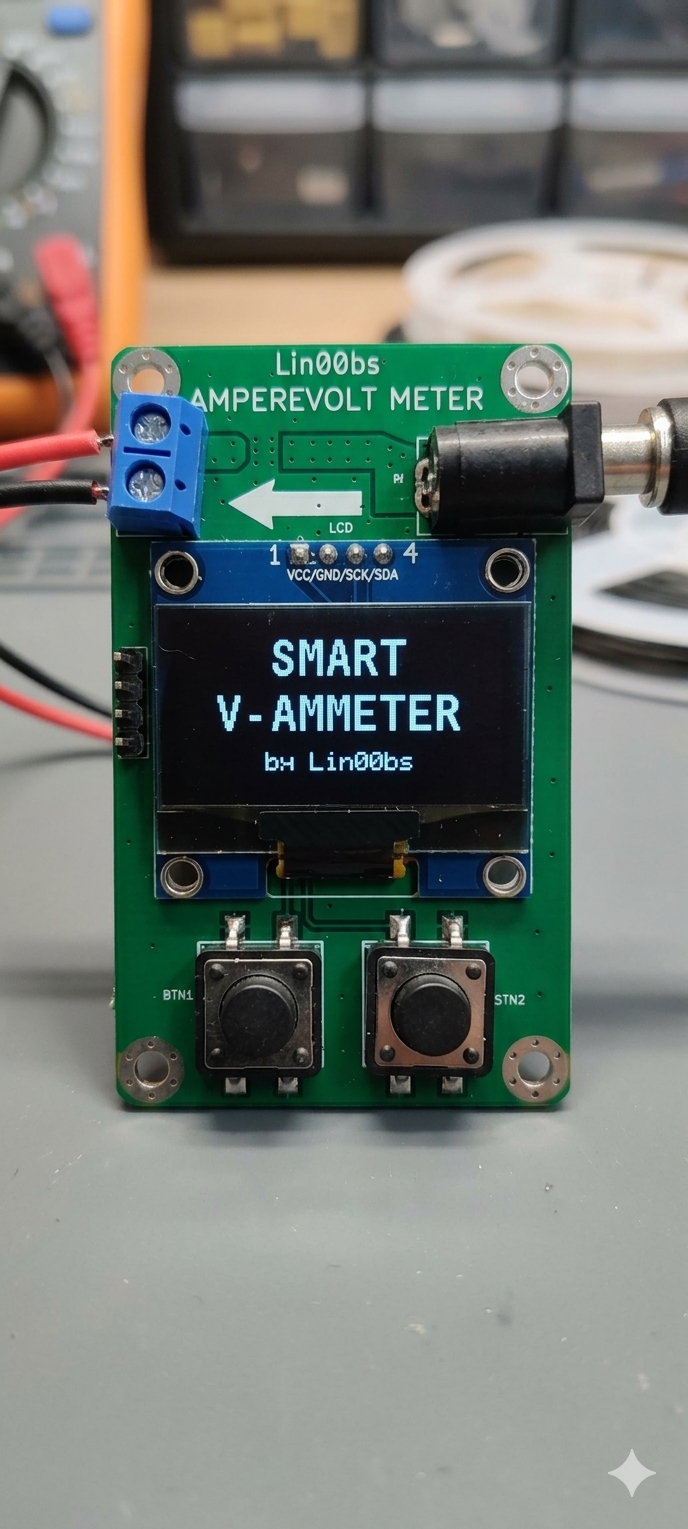
To make this calibration process safe, fast, and highly accurate, I developed a dedicated tool: the Lin00bs Smart V-Ammeter.
At first glance, it looks like a clean, well-built digital panel meter. But it packs impressive specifications and a hidden superpower: a dedicated zeroing button that allows for instant relative measurements.
The Game-Changer: Relative Measurement Mode for RF Bias Tuning
The real power of this meter lies in the feature listed as “It” (Delta Current) on the screen.
When you are adjusting the idle current (bias) of an RF final stage, there is already a baseline current flowing through the driver stage or auxiliary circuits. You don’t want to do mental math trying to subtract the baseline while carefully turning the potentiometer.
With the Smart V-Ammeter, you simply connect your radio equipment, wait for the baseline readings to stabilize, and press the button on the panel. The current display instantly resets to 0.0 mA. From that moment forward, the meter only displays the exact increase in current for the specific transistor you are tuning. No more distraction, no more mental math—just pure, real-time tuning data.
Hardware & Technical Specifications
I didn’t compromise on the internals, making sure this tool can handle serious bench work:
- The Brains: The device is built around the high-precision INA226 current and power monitor chip, ensuring rock-solid stability and digital accuracy over the I2C bus.
- Shunt Resistor: It utilizes a high-quality 10 mOhm ultra-low resistance shunt, minimizing the voltage drop inserted into your critical RF supply lines.
- Measurement Range: It supports a wide operating range, measuring up to 10 Amps, making it perfect for anything from low-power handheld radios to high-power transceivers.
- Exceptional Precision: Thanks to the 16-bit ADC inside the INA226, the meter delivers incredible resolution down to tenths of a milliamp (0.1 mA). You can catch even the slightest current variations during adjustment.
Key Features:
- Clear OLED Display: Sharp readouts for Total Current (
I), Delta Current (It), Voltage (U), and Power in Watts (P). - Intuitive Controls: Two robust pushbuttons right below the screen for mode selection and quick zeroing.
- Rugged Connectivity: Heavy-duty screw terminals for the main load lines and a standard DC barrel jack for reliable logic power.
Conclusion
The Lin00bs Smart V-Ammeter is designed specifically to take the guesswork out of calibrating sensitive RF and radio equipment. With its 10A limit and 0.1 mA precision, it bridges the gap between bulky laboratory multimeters and standard, low-res panel meters.
In a future post, I will dive deeper into the schematics, the board layout, and how I programmed the relative mode function.
What kind of RF projects are you working on right now? Let me know in the comments below!
Downloads & Open-Source Files
I am sharing this project with the community so you can build your own or adapt it to your workbench needs. Below you will find all the necessary files to replicate the project:
- Schematics & PCB Layout: Detailed circuit diagrams to see how the INA226 and display are wired.
- Gerber Files: Ready-to-send files for ordering PCBs from any manufacturing service.
- Firmware: The complete source code/binary to flash onto the microcontroller.
Disclaimer
Please Note: This project is provided “as-is” for educational and hobbyist purposes, without any warranties of any kind. Any commercial use of this project without my explicit consent is strictly prohibited. Working with RF power equipment, transmitters, and high-current power lines carries inherent risks. I am not responsible for any damage to your equipment, components (such as blown LDMOS/FET transistors), or any personal injury or accidents that may occur while replicating or using this device. Please proceed with caution and at your own risk.